
How AI agents will change commodity trading
5 sections
Trading software has always recorded work that people did. A trader agrees a deal, an operator books the freight and checks the documents, and someone types the result into a CTRM or a spreadsheet.
AI agents change this. An AI agent reads the messages, makes the offer, checks the documents and tracks the cargo. It also makes most of the decisions on the way, inside limits that the owner sets.
This is happening now. The length of a task that an AI agent can finish alone has doubled about every seven months for six years.1 Trading firms also have a reason to move. The industry’s gross margin fell from a record $150 billion in 2022 to about $95 billion in 2024, and the cost of each trader, before bonus, has gone up more than 25% since 2019.2 BCG wrote this year about AI in energy trading: “Laggards find it hard to catch up quickly.”3
Today a trading firm is limited by three things: capital, relationships and its people’s time. We think AI agents take away the third. This post looks at what the AI agent takes over, what stays with people, how the firm changes, and who can compete. A firm built this way from the start is an AI-native trading firm.
What the AI agent takes over
An AI agent can carry almost every step of a deal, and make the small decisions on the way.
The work. Take one container deal, a shipment of a food ingredient. An AI agent can carry almost every step.
- Inquiry. The AI agent reads the buyer’s WhatsApp message, looks up past deals and sends the offer.
- Negotiation. It answers each message from the cost, the freight and the lowest price the firm will take.
- Contract. It sends the recap email and writes the contract. A person signs.
- Freight. It asks for quotes, compares them and books one.
- Sample. It follows the sample until the buyer approves it.
- Documents. It checks the letter of credit and the certificate of analysis, and sends the shipping instructions.
- Shipment. It tracks the container every night and chases late documents.
- Claim. It collects the contract, the inspection report and the photos, and proposes an answer.
Most of the decisions. It is easy to think that the AI agent prepares and the person decides. We do not think it will stay that way. Most decisions in a trade are small and follow from the facts: which freight quote to take, what price to answer with, whether a document matches the credit. An AI agent that has every past deal and every message in front of it can make these calls, at any hour. Negotiation is the same. A lot of it happens in writing, on WhatsApp and email. The bigger calls, such as how large a position the firm will carry, become limits that the owner sets a few times a year. People will make far fewer decisions than they do today.
Work that people do badly. Banks refuse the documents on first presentation for 65% to 80% of letters of credit.4 Each refusal costs fees and days. An AI agent checks every document against the credit before it goes to the bank.
Work that nobody had time for. An AI agent can screen every counterparty and its owners for sanctions and bad news every night. No small firm does this by hand.
Small deals. A buyer who wants one container was not worth a trader’s time. An AI agent can answer that buyer on WhatsApp all day, so a firm can sell to many small buyers directly.5
What stays with people
Relationships, responsibility and capital stay with people.
Relationships. A supplier gives credit to a trader they have met. A buyer signs a one-year contract after a visit to the warehouse and a dinner. This is where people still decide best, because what a trader learns on a visit is not in any message, and the AI agent does not have it. Good traders visit their main suppliers and buyers about twice a year.5 With AI agents on the messages and the documents, they have time to do it more often.
Responsibility. A contract is signed by a person. A bank or an auditor will still ask who looks after the money and the risk. A growing firm still needs that person, but not a department around them.
Capital. An AI agent cannot put money into a cargo. Capital, bank lines and a name take years to build.
The same team can run more desks
Work no longer sets the size of the team. Relationships set the number of desks.
Most trading firms are built the same way. Each trading desk covers one product or one group of products, and it owns its profit and loss. All the desks share one support team: operations, shipping, trade finance, risk and finance. In a typical trading unit only about one person in three is a trader.6
The others are there because of the amount of work. One person cannot find suppliers, answer buyers, arrange finance and follow twenty shipments at the same time. A small firm with $50M of revenue has five to seven people today.5
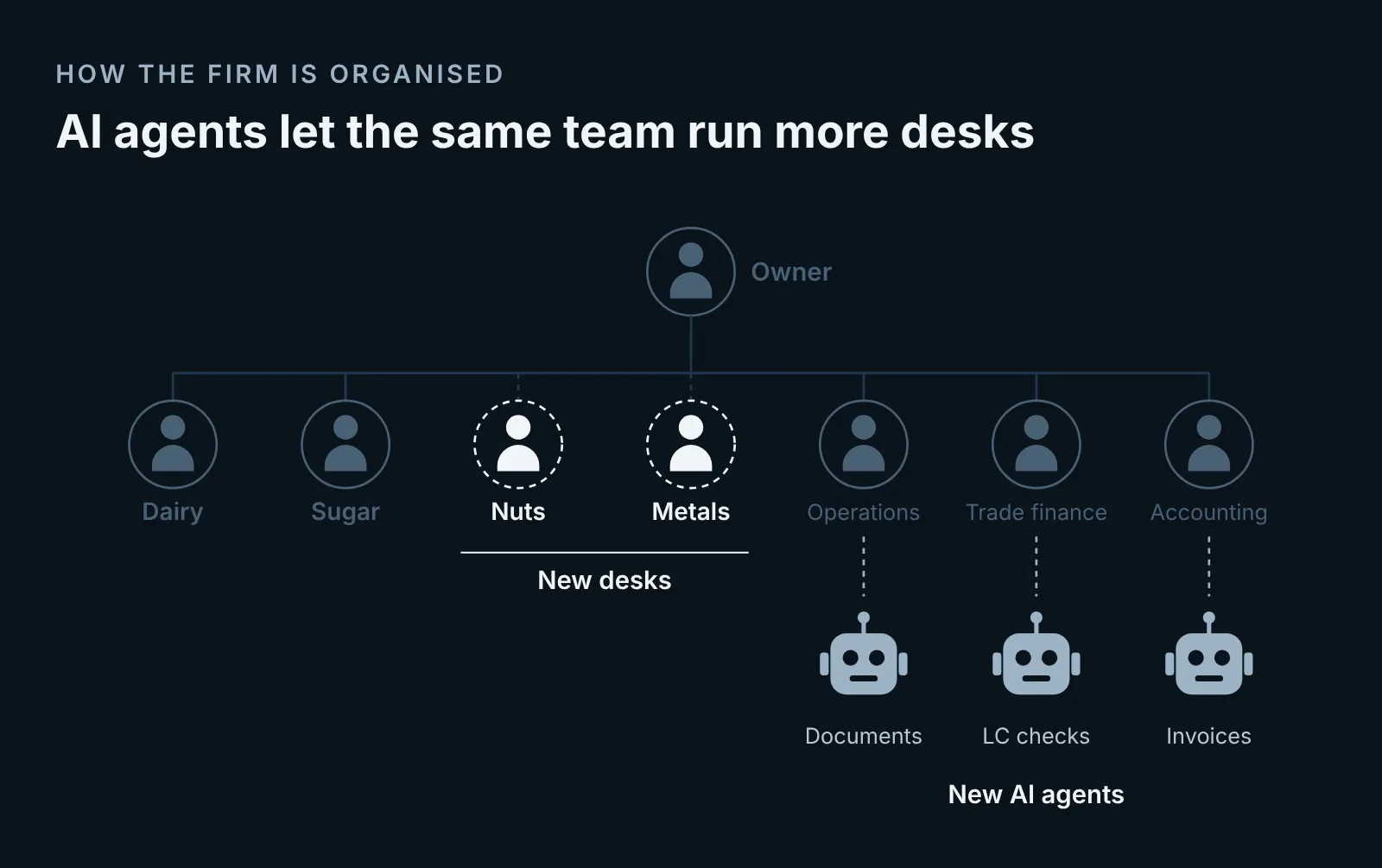
The amount of work no longer sets the number of people. A new firm can start with one to three people. A firm that already has a team keeps its structure. Its support people stop typing and chasing, and look after the cases the AI agents cannot settle.
Relationships set the number of desks. A firm can open a new desk when it has a person whom the suppliers and buyers of that product trust, and the capital to back them. A trader who no longer writes messages and chases documents has time to build those relationships in a second and a third product. We think a firm can run two or three times as many product lines with the team it has.
Control moves from people to limits. Firms also split work for control. When two people each do part of a deal, a mistake or a fraud is seen by the second one, and an employee who leaves cannot take the whole business along.5 This takes extra people. When AI agents do the work, the owner can keep control with a few rules.
- The owner sets the limits. The lowest price, the credit for each buyer and the size of a position are set once. The AI agent decides inside them. Anything outside the limits goes to the owner first.
- Money needs a second person. Someone other than the trader, often the owner, approves every payment, after the AI agent has checked it against the contract and the bank details.
- The record belongs to the firm. Every deal is in the system, not in one person’s phone. The owner can read any deal on the same day, and a trader sees only the numbers of their own desk. If a trader leaves, the history stays.
- Important suppliers and buyers know more than one person. Software cannot do this. The owner still has to visit.
What this changes in the industry
Small firms run their own operations, and more traders start their own firm. Capital decides where.
Small firms can run their own operations. Small trading firms are not new, but most give their operations to someone else: a service provider, a trade finance fund or the big firm they buy from.5 AI agents let a small firm do this work itself.
More traders will start their own firm. A trader at a mid-size firm makes $1.5M of P&L in a year and takes home about $390k: a salary plus a bonus of 10% to 15% of that P&L.7 The firm keeps the other $1.1M, which pays for the team, the systems and the capital around the trader. When AI agents do the team’s work, what the trader brings is the relationships with suppliers and buyers, and those already belong to the trader. A trader who leaves no longer has to build a team first.
A firm that has capital, bank lines and a name can make a different offer: a desk, its capital and a bigger share of the profit. We think both will grow, new firms and firms that work this way.
Mid-size firms can add product lines. Trading desks usually grow by starting with a few products and expanding into as many profitable ones as they can.6 AI agents make each step cheaper, because a new product no longer needs more operators. Capital is still the limit. A mid-size firm pays more for capital than the big firms, and after the trade finance frauds of 2020 banks cut their lines to small and mid-size traders.58 Inside that limit, we think the mid-size firms that move early will grow into large ones.
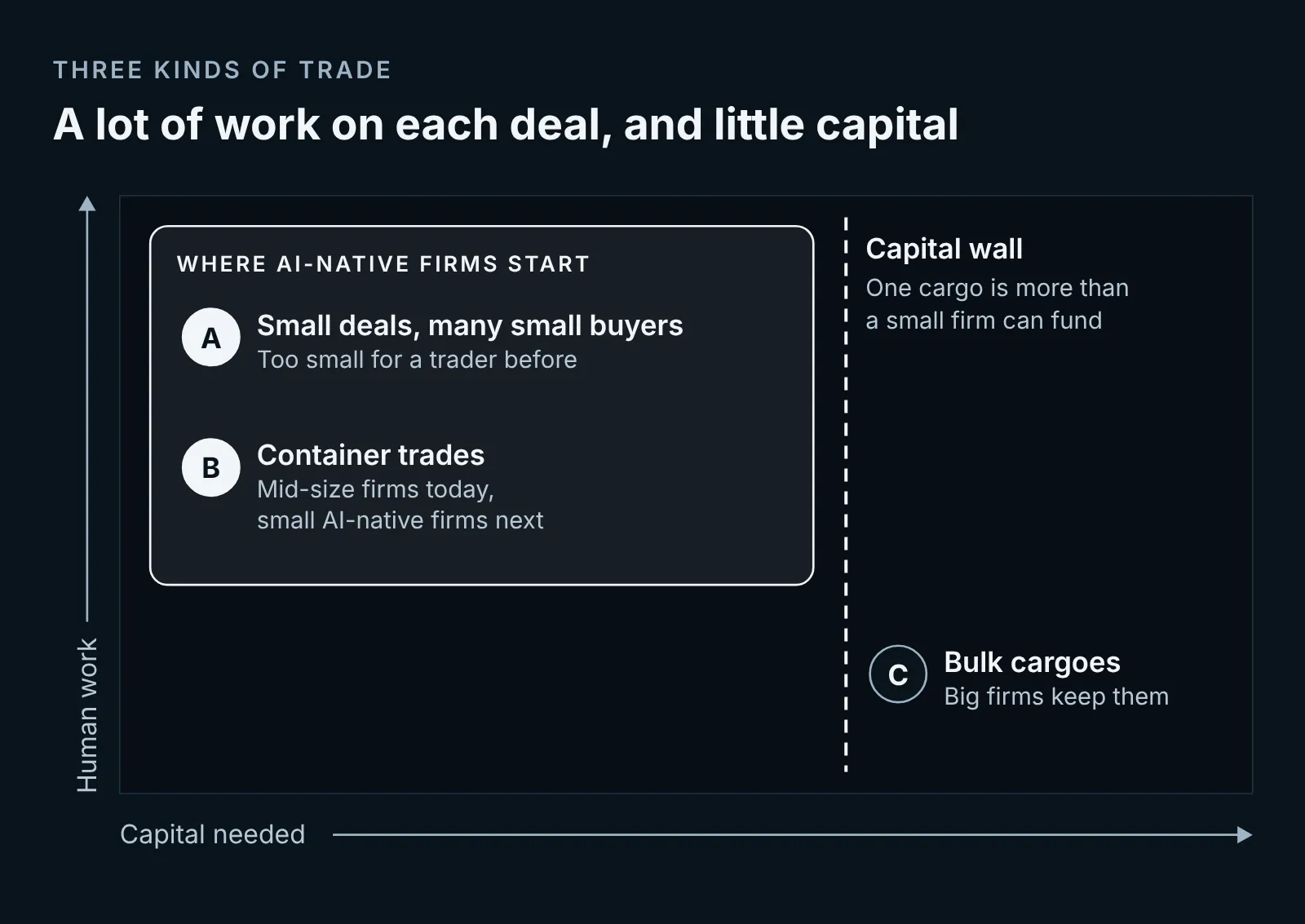
Capital decides where the new firms start. A container deal ties up a few hundred thousand dollars, and suppliers give credit at this size. A bulk cargo is worth from a few million dollars to more than $100M. The big firms are strong because of capital, not people: Vitol made more than $12 billion of net profit a year over three years, about $6M for each employee.9 So bulk stays with the big firms for now. The AI-native firms will start in container trades such as dairy, food ingredients and minor metals, where every deal has a lot of work and little capital.
What a trading firm should do now
Give the work to AI agents and put people where trust is built.
The cost of doing the work of a trade is falling fast. A firm that still pays people to type, chase and check will have higher costs than a firm that gives this work to AI agents, and it will answer buyers more slowly.
Capital and trust built in person will stay scarce. A firm should put its people where trust is built: in front of suppliers, buyers and banks.
The firms that move first will take the small buyers and the good traders, and both are hard to win back. We think most trading firms will be organised this way within five years. The choice for a firm today is to make this change itself, or to compete later against firms that already have.
Footnotes
-
METR, March 2025. The measure is the length of task, in human working time, that an AI agent completes half of the time. ↩
-
Oliver Wyman, commodity trading reports for 2024 and 2025. ↩
-
BCG, Putting AI to Work in Energy Trading, July 2026. ↩
-
Christopher Byrnes of Documentary Credit World, writing about an ICC briefing on discrepancy rates, in Trade Finance Global, August 2022. ↩
-
The small firms, team sizes and cases in this post are from videos by Damien Würsten, a physical trader: Why commodity trading firms stay small, The future AI commodity trading firm, The one-person commodity trading firm and Masterplan to build a future-proof empire. ↩ ↩2 ↩3 ↩4 ↩5 ↩6
-
Bain & Company, How Commodity Producers Can Raise Their Trading Game, March 2019. ↩ ↩2
-
We use a $200k salary and a bonus of 12.5% of P&L. This is an example, not data from one firm. A recruiter quoted by eFinancialCareers (April 2024) puts a merchant trader’s payout at 10–15% of the book, minus costs. Selby Jennings (December 2025) gives 8–15% for oil trading. ↩
-
Global Trade Review, 2024. ↩
-
Financial Times, republished by swissinfo, September 2025. ↩
Flowpact is by invitation. Request an invitation